
Puppy scams have been on the rise, especially through buying puppies in online scams or craigslist puppy scams. You must be particularly cautious if you wish to buy a puppy online.
This article will show you how to spot a puppy scammer, and in particular will illustrate how to spot a corgi puppy scam. But the advice given here is generally the same for any breed of dog.

How Puppy Scams Operate
Puppy scammers and pet scammers set up fake advertisements for puppies online or through sources such as craisglist. Often the scammer will go to great lengths to look legitimate, including making a breeder website and breeder social media accounts.
They might even run paid ads that can appear on legitimate sites without the site knowing that it is hosting a fraudulent advertisement. One such ad appearing on this site is what motivated me to write this article!
Once an unsuspecting buyer makes contact with the scammer, they will be told how to pay for a puppy. The seller will promise safe shipping. Once a payment is made, the scam pet seller will often ask for more money for extra necessary options, such as a travel safe carrier, vaccines, or insurance. This is a sign of a scam. They got you once and are now coming for more.
Scammers have even gone so far as to set up fake looking airlines that will then ask you for more money!
When the time comes for the puppy to arrive, the scammer disappears and quits responding to inquiries. Sadly, that cute puppy was a fake and never existed. You can read about one person’s experience getting scammed here.
Don’t let this happen to you!
How to Spot a Puppies For Sale Scam
There are a number of things that should set off alarm bells when you are looking for a puppy, especially if you are looking online.
1. Reputable Breeders Do Not Heavily Advertise
First and foremost, be aware that the best breeders usually do not do much advertising. They may have a Facebook page or other social media page and they may have a website. They might also use various listing services such as GoodDog or perhaps PuppyFind (which is itself not free from scams).
What they won’t do is run Google ads and they won’t give big marketing pitches. This is especially true with highly sought after breeds such as corgis. You are also probably not going to find them on Craigslist. A good breeder doesn’t have to give a marketing pitch and place advertisements to place their purebred puppies. At least not with corgis.
In fact, you should expect to be questioned by a reputable breeder as to why you are deserving of one of their puppies. It is you that might have to sell yourself to the breeder, not the other way around!
Here is a Google Adsense ad that appeared on this site that I immediately blocked and reported to Google. I will use some examples from the site that it led to to further show you how to spot a fake puppy website.

A reputable corgi breeder will not run an ad like this. Only a scammer or a puppy mill will do this. And you don’t want to buy a puppy from a puppy mill either!
Website owners who run Google ads, such as myself, are not able to prescreen ads. We can block them when we find them, but we can’t prescreen. So, you could see an ad such as this on a very reputable site. Many large well known sites run Google ads. That does not guarantee that the ads that you see there are reputable.
As an aside, if you ever spot such an ad on this site please screen shot it and/or note the url that it directs to and contact me. I can then block the ad from the site. Obviously, I do not wish ads such as this to appear here.
2. Puppy Scam Websites Often Have Generic Names
While I know of a few reputable breeders who use generic sounding or marketing sounding names for their website, most such names are scammers or possibly puppy mills. Names such as Classic Corgi Puppies, Adorable Corgi Puppies, High Quality Corgi Puppies, Healthy Corgi Puppies, Ultimate Corgi Puppies, etc. are typical of the names used by scammers and are names that came up as suspicious when researching this article. You can read the BBB report on the Ultimate Corgi Puppies scam here.
A real breeder will normally use their own name or a less marketing sounding name. Yes there are exceptions, but beware of any site that sounds like a generic sales pitch with the name.
3. Pet Scam Sites Use Stolen or Stock Photos
One huge giveaway of a pet scam website is the use of mismatched photos. Because the scammer doesn’t actually have a litter of puppies to photograph, he or she will grab photos from the internet or social media platforms. There also will rarely be multiple photos of each puppy.
Here is an example from the site that had the Google ad on my site:

Notice how each puppy is in a different location. That is pretty much a dead give away of a scam site. There is also a lack of consistency between the shape and sizes of the puppies. One has a bob tail, another is docked, and yet another has a tail. While a litter of corgis can have different colors in the same litter, you are not likely to see this much disparity in color, shape and size of the puppies.
Something you can also try is doing a Google reverse image search of the photos. Here is how to do that. You sometimes will find the original source of the images that way or uncover other suspicious items.
In this case, a reverse image search of a very unusually colored puppy provided this result:
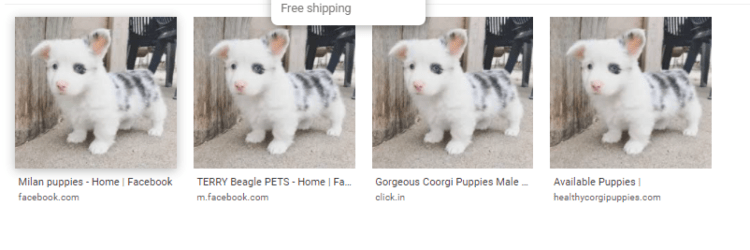 This puppy appeared on Facebook twice, a questionable puppy advertising site (do not go there, it popped up questionable ads for me), and an entirely different scam site that was identical to the one that I grabbed the photo from.
In fact, I found photos from the site on three more identical scam sites.
The identical sites also all had fake testimonials from supposedly happy buyers. In fact, the testimonials in some instances did not even match the site name. Take a look at these. The name of the site was not Protection Dog Sales or Amazing Cute Healthy Corgi Puppies.
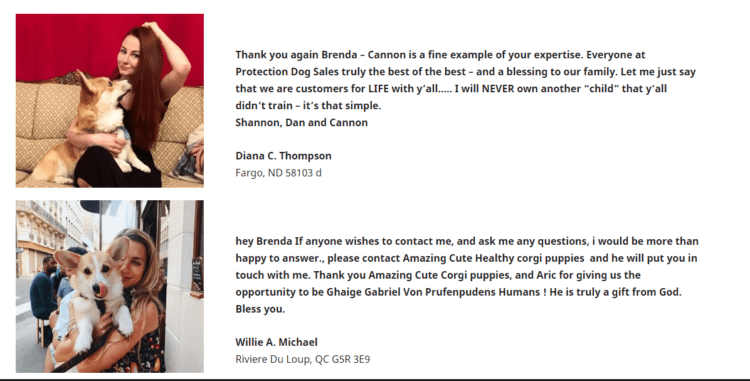
These fake testimonials appeared on all of the identical sites and most were holding full grown corgis. But one of the websites was registered just 5 months ago.
That leads us to the next point about checking site registration.
4. Puppy Scam Sites Are Usually Not Very Old
You can check the registration date of a website on places such as Domain Tools. Because scammers invariably get caught and reports start getting filed, they will often turn over sites. That mean their website is often likely to be less than a year old.
Remember how I found that puppy on multiple different, and essentially identical sites? All were registered within the last year.
5. A Real Breeder Will Not Have Questionable Payment Terms
It is not uncommon for breeders to require deposits on puppies. However, asking for payment by Western Union, Mailed Cash, or use of a more obscure online payment form is a red flag. As noted by the Denver Times:
“The scammers’ tactics are evolving. Many now use mobile payment apps like Zelle and CashApp, replacing wire transfers. They often use fake online forms to process credit card information. Then, when the cardholder gets an error message, they ask for electronic funds and often use the credit card information to fund their scams.”
6. Beware of Craigslist and Unsolicited Social Media Messages
As I previously noted, Craiglist can be a sketchy place to find a purebred puppy. If you are looking for a purebred puppy from a reputable breeder, you are not likely to find it on Craigslist. On Social Media, scammers will often troll dog breed groups and, when a person posts that they are looking for a puppy, the scammer will contact them.
If you are directed to a Facebook page, look for legitimate engagement on the page from multiple different people and look for reviews.
Of course a real breeder might contact you too, so doing your due diligence is crucial.
7. Use Pet Scams to Check For and Report Fraud
Petscams is a site dedicated to reporting on pet scammers, and you can also report scammers there if you have been scammed. Not all will be on there, and scammers turn over their websites frequently, but it is a good resource to look at. Unfortunately, not all of the sites that I found when working on this article were not on there. However here is their report on the site that I used as examples in this article.
You can also Google the site name and the word “scam” to see if you can find complaints about the site.
8. Ask Many Questions and Ask for Photos with Proof of Date and Video
When talking to a breeder, if you have any question of their legitimacy, ask for multiple photos plus video of the puppy with a handwritten paper with the date on it. While photos can be photoshopped, and I have seen that happen, it is much harder to fake video.
Question the breeder about their breeding practices and genetic testing etc. Ask what breed clubs they belong to and check membership lists. A Scammer might not be as familiar with the breed as they should be and your questions will reveal that. Not all breeders belong to clubs, especially not hobby breeders who do not show their dogs, but club membership is definitely a good sign.
Ask for references and contact them. These can be faked. But a reputable breeder will likely have numerous people they can give you to contact.
Often when questioned extensively and asked for video, scammers will either become offended or quit responding.
9. Join Social Media Groups Dedicated to Keeping Out Scammers
For Corgis, the Facebook Group Corgi Puppies Without Scams seeks to eliminate fake breeders.
You can also look for breed specific groups that screen members. When in doubt, ask in such groups for references to a specific breeder or for recommendations of breeders to contact. Contact breeders through breed specific clubs such as The Pembroke Welsh Corgi Club of America or regional specialty clubs to assure that you are working with a real breeder.
10. If it Seems Too Good to be True or Sketchy, it Probably is!
Trusts your gut. Someone offering a normally expensive breed for cheap should raise a lot of questions. If the person you are talking to seems sketchy or something seems off, that is a strong sign to look elsewhere.
Due Diligence Checklist for Avoiding Puppy Scams
Here is a quicker checklist for avoiding a corgi puppy scam:
- Check for a website. Does it have a generic name? Scammers often use marketable website names.
- Check PetScams.com to see if the site is listed there.
- Are the puppy pictures consistent? Scammers will often have photos of many different puppies in different locations.
- Are there inconsistencies in information and testimonials on the site? Scammers reuse sites and often leave mistakes.
- Check the registration date of the site. If it is recent, it is more likely to be a scam.
- Do a reverse image search of the photos on the site. If images show up on multiple sites or appear to be stolen from social media, it is a fake site.
- Ask many questions and ask for photos and video of the puppy with a paper with the date written on it.
- Check social media groups for references and ask if anyone has dealt with the breeder.
- Be very wary of any unusual payment terms or methods. If you are asked to use an obscure payment systems, mail cash, or use Western Union, it is probably a scam. Do not give your credit card information directly to a breeder or website.
- If it sounds too good to be true, it probably is. If it seems sketchy to you, it probably is.
What a Real Breeder Looks Like

In my recent search for a corgi puppy, the breeders I have contacted all have Facebook pages with a high level of real engagement and multiple reviews from clearly real people over a lengthy period of time. They have posted lots of photos of their puppies, where it was clear that they were from the same litters, and they showed full knowledge of the breed. They answered my questions in a way that projected knowledge and trustworthiness.
Many were also showing in conformation and thus were members of a regional club or had a history online of show results. Those that did not show had an online history of mentions to their breeding program. Most of them I had seen recommended repeatedly in corgi Facebook groups and/or I knew of them from their own knowledgeable posts in corgi groups.
Their websites were registered quite some time ago and were not full of slick marketing and sales pitches. They often had photos of their Boys and Girls for breeding on their sites with pedigree and health testing information.
They all require buyers to fill out a questionnaire or require a phone interview. Getting a puppy from any of them is not a guarantee. I have to be prepared to show them that I am worthy of one of their babies. I also will have to wait for some time.
Even breeders I see that are hobby breeders who are not showing dogs for conformation and who don’t have websites usually have a history online and show obvious signs of being legitimate. They will provide you with the photos that you ask for and respond intelligently to questions. They too are often in groups and post in a way that shows that they are a real and trustworthy person.
Compare all that to the scammer site examples that I provided earlier.
If it seems sketchy it probably is. Be safe everyone!